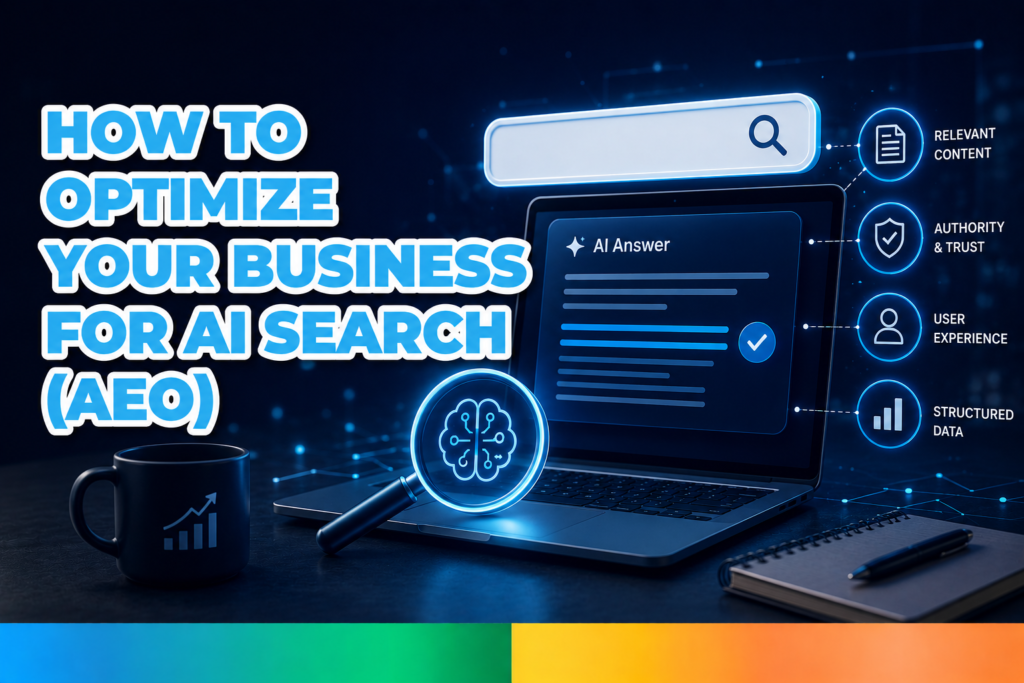

Welcome to the era of Answer Engine Optimization (AEO). SEO isn’t dead, but it has a new partner.
For over twenty years, businesses have optimized their websites for search engines.
The formula was familiar:
- Find the right keywords.
- Build backlinks.
- Improve domain authority.
- Publish quality content.
- Rank on Google’s first page.
These strategies still matter. But something fundamental has changed.
Millions of people are no longer typing questions into Google first. They’re asking ChatGPT.
Or maybe they’re using Gemini.
They’re searching with Claude, Perplexity, Copilot, and other AI assistants.
Instead of ten blue links, users now receive a direct answer. And if your content isn’t part of that answer, you may never be seen.
What is Answer Engine Optimization (AEO)?
Answer Engine Optimization is the practice of creating content that AI assistants can easily understand, trust, and quote when generating responses.
Unlike traditional SEO, where success means ranking highly in search results, AEO focuses on becoming part of the answer itself.
Instead of asking: “How do I rank #1?”
Businesses should start asking: “How do I become the source AI chooses to reference?”
That’s a completely different mindset.
SEO vs AEO: What’s the difference?
Although SEO and AEO complement each other, they prioritize different signals.
| Traditional SEO | AEO |
| Optimizes for search engines | Optimizes for AI answer engines |
| Focuses on keywords | Focuses on questions and answers |
| Rewards backlinks | Rewards clarity and credibility |
| Competes for rankings | Competes to be cited |
| Traffic comes from clicks | Visibility comes from mentions and citations |
Think of it this way:
SEO helps people find your website. AEO helps AI find your knowledge.
Businesses will increasingly need both.
Why AI prefers certain content?
Large Language Models don’t browse the internet the way humans do.
When AI systems generate answers, they tend to favor content that is:
- clearly structured
- easy to summarize
- factual
- well organized
- trustworthy
- written in natural language
A long article filled with unnecessary jargon may rank in Google but still be difficult for an AI model to extract information from.
Meanwhile, a concise, well-structured guide may become the preferred source.
What makes content AI-Friendly?
If you want AI platforms to reference your business, your content should be designed for humans and machines.
Here are several best practices.
1. Answer questions directly
Many businesses spend several paragraphs introducing a topic before answering the user’s question. AI prefers the opposite.
Give the answer first. Then expand with supporting information.
For example:
Instead of:
“Artificial Intelligence has become increasingly popular over the last decade…”
Try:
“AI can reduce customer support costs by automating repetitive conversations while improving response times.”
Then explain why.
2. Use clear headings
Well-organized content is easier for AI systems to understand.
Structure articles with logical sections such as:
- What is…
- Why it matters
- Benefits
- Common mistakes
- Step-by-step guide
- Frequently Asked Questions
This helps both readers and AI models navigate your content.
3. Write in natural language
People don’t search with isolated keywords. They ask questions, now more than ever.
Instead of optimizing for:
CRM software
Think about questions like:
- Which CRM is best for small businesses?
- Do I need a CRM?
- How does a CRM improve sales?
Content that mirrors natural conversations is more likely to appear in AI-generated answers.
4. Build topical authority
Publishing one article isn’t enough. Search engines and AI systems increasingly reward websites that demonstrate deep expertise within a topic.
Instead of writing random blog posts, create content clusters about the topic you’re an expert about.
For example:
Artificial Intelligence
- What is AI automation?
- AI for customer service
- AI for sales
- AI implementation mistakes
- AI workflows
- AI agents
- AI strategy
The more comprehensive your expertise appears, the more trustworthy your site becomes.
Can you track AEO performance?
This is one of the biggest challenges today. Unlike traditional SEO, there isn’t a universal ranking position for AI answers.
There is no equivalent of “Position #1.”
Instead, businesses should monitor signals such as:
- brand mentions in AI-generated answers
- increases in direct website traffic
- referral traffic from AI platforms
- branded searches
- citation frequency
- prompt testing (“Would ChatGPT recommend my company?”)
The tools are evolving quickly. Even major marketing platforms are adapting.
HubSpot has introduced AI search visibility features, while Semrush is expanding its AI monitoring capabilities, reflecting how rapidly the industry is changing.
The best AEO strategies right now
While AI search continues to evolve, several practices are already proving effective.
Publish helpful content
Focus on solving real customer questions instead of writing exclusively for algorithms.
Keep your brand consistent
Use the same company name, messaging, and positioning across your website, social profiles, directories, and publications.
Consistency helps AI systems associate information correctly.
Earn authority
Being referenced by respected publications, industry websites, podcasts, and professional communities increases your credibility.
AI models tend to rely more heavily on authoritative sources.
Create content worth quoting
Lists.
Definitions.
Frameworks.
Step-by-step guides.
Statistics.
FAQs.
These formats are much easier for AI to cite than long promotional paragraphs. And easier to read on mobile devices!
The future isn’t SEO or AEO. It’s both.
Some businesses are treating AEO as the replacement for SEO. That’s a mistake.
Google still processes billions of searches every day, so traditional SEO remains essential.
But AI search is growing rapidly, and businesses that prepare now will have a significant competitive advantage.
The winners won’t optimize for search engines alone. They’ll optimize for every place people look for answers.
Ready to make your content AI-Ready?
At We Build It, we help businesses prepare for the next generation of search.
From SEO strategies and technical optimization to AI-ready content architecture, topic clusters, and conversion-focused websites, we build digital ecosystems designed to perform in both traditional search engines and AI-powered answer platforms.
Whether you’re creating a new content strategy or updating an existing website, we’ll help you build content that ranks, gets cited, and generates qualified leads.
Let’s build your visibility for the future of search.
Frequently Asked Questions
What is AEO?
Answer Engine Optimization (AEO) is the process of optimizing content so AI assistants like ChatGPT, Gemini, Claude, and Perplexity can easily understand, reference, and cite it in their responses.
Is SEO still important?
Yes. SEO remains essential for search engine visibility. However, businesses should also optimize for AI-powered search experiences by creating structured, authoritative, and answer-focused content.
How is AEO different from SEO?
SEO focuses on ranking web pages in search engines, while AEO focuses on helping AI systems extract and present your content as part of direct answers.
Can AI-generated answers drive website traffic?
Yes. While users may receive direct answers, businesses that become trusted sources can benefit from increased brand recognition, direct traffic, branded searches, and referral traffic from AI-powered platforms.
How can my business prepare for AI search?
Start by creating high-quality, well-structured content that answers real customer questions, organize your content into topic clusters, maintain consistent branding across the web, and continue building your site’s authority through valuable resources and industry recognition.