


Interactive content for lead generation is no longer just a trendy buzzword—it has become the gold standard for digital marketing in 2026. Today’s users are completely over static forms and generic ebooks. Instead, they demand immediate value, personalization, and digital experiences that speak directly to their needs.
In this guide, you’ll discover which types of interactive content drive the highest-quality leads, how to seamlessly weave them into your strategy, and why optimizing for the new wave of AI-driven Generative Engine Optimization (GEO) is now a must for any digital business.
What Is Interactive Marketing Content?
Interactive marketing content is any digital format that requires active user participation—whether that’s answering questions, inputting data, exploring options, or making choices. Unlike static content (like a traditional blog post, a standard PDF, or a linear video), interactive content adapts the experience in real time based on each person’s input.
This built-in personalization is exactly why it’s such a powerhouse for capturing leads without relying on old-school forms. Users feel like they are getting tailored value in exchange for their information, rather than just filling out a chore of a form.
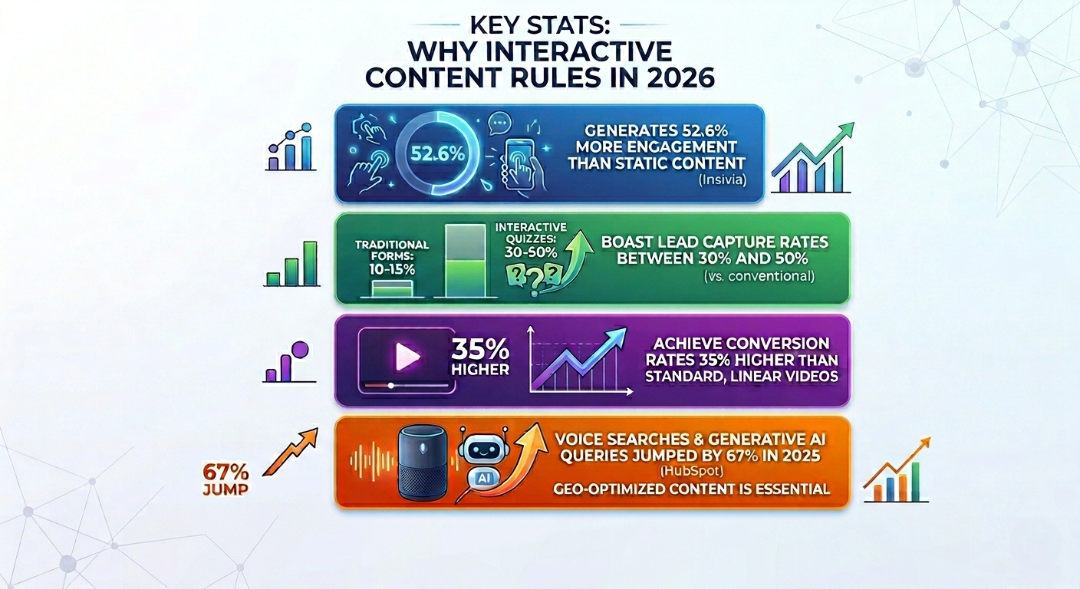
Types of Interactive Content to Drive Leads in 2026
Before picking a format, it helps to understand what each does best and where it fits in your marketing funnel. Here are the top-performing interactive content types this year:
1. Quizzes and Diagnostic Tests
Interactive lead-generation quizzes are the undisputed kings of organic virality. The setup is simple: the user answers 5 to 10 questions and receives a personalized breakdown (like their buyer profile, digital maturity level, or ideal strategy). The lead form pops up right before the final reveal—exactly when user curiosity and motivation are at their peak.
2. Interactive Calculators and ROI Tools
Online ROI calculators are the highest-converting interactive lead magnets in the B2B space. Users plug in their own metrics (like budget, employee count, or sales goals) and get a customized estimate of their potential returns. This tool perfectly embodies the concept of Zero-click content—delivering upfront value before asking for a thing.
Pro-Tip on Conversion: The secret to using interactive calculators effectively is placing the lead form after the user inputs their data but before displaying the full results. They’ve already done the work; they are fully invested.
3. SEO-Optimized Interactive Infographics
These tools blend the organic search visibility of classic infographics with the smart segmentation of dynamic content. They allow users to filter data, expand specific sections, or customize the visuals based on their industry. They are massive wins for SEO because they naturally attract backlinks and keep users on your page way longer.
4. Free Assessments and Audits
An interactive audit (covering SEO, operations, or content strategy) is incredibly effective for B2B lead generation. The user walks away with tangible, professional value, while you capture highly detailed qualification data to fuel your sales team.
5. Interactive Sales Videos
Interactive sales videos let viewers choose their own narrative path, answer questions, or dive deeper into specific features without ever leaving the video player. Platforms like Tolstoy, Wistia, and Vimeo now offer these features right out of the box.
6. Gamification for Lead Generation
The top gamification trends for 2026 feature spin-to-win wheels, leveled challenges, progress badges, and point systems. Gamification doesn’t just capture a lead; it keeps people coming back and building a relationship with your brand. It is a massive hit for e-commerce and customer loyalty programs.
Interactive Lead Magnet Strategies That Actually Convert
Simply building a quiz or a calculator isn’t enough. The interactive lead magnets that actually move the needle share three core traits:
- A specific, believable promise: “Find out in 3 minutes which content strategy fits your business” converts significantly better than a generic “Download our marketing guide.”
- Zero friction at the start: Don’t force users to register just to try it out. Let them interact freely; show the form only after you’ve proven your value.
- Actionable, personalized results: The final breakdown should feel custom-made for the user. Use conditional logic to tailor your recommendations based on their specific answers.
How to Capture Potential Clients Without Traditional Forms
This is one of the most common questions in modern marketing, and the answer is simple: give value before you ask for data. Here are the most effective ways to do it:
- Gated progressive results: Show a high-level summary of the results for free, then offer the deep-dive, comprehensive report in exchange for their email.
- Answer-based personalization: Tailor your final Call to Action (CTA) based on their responses. If a quiz reveals they manage a massive sales team, your CTA should dynamically switch to “Book a team demo.”
- Built-in social proof: Dropping a quick line like “Over 4,200 marketing pros have taken this audit” instantly boosts completion rates.
Boosting Conversion Rates with Quizzes and Calculators
Maxing out your conversions requires a mix of smart user experience (UX) and strategic timing. Keep an eye on these key factors:
Design and UX
- Visible progress bars: These simple visual cues slash drop-off rates by 25% to 40%.
- Images and emojis in answers: They keep things fun and reduce the mental effort required to finish.
- Mobile-first design: Over 65% of interactive content experiences happen on phones.
Lead Capture Architecture
- The Sweet Spot: Place your form between the final question and the results page. This is the moment of peak anticipation.
- The Power of Choice: Offer a basic summary on the spot, with an option to get the full, detailed report sent via email. The email option converts beautifully because the user feels in control.
- Run A/B Tests: Constantly test the number of questions (5 vs. 8), your CTA copy, and the layout of your lead form.
Post-Capture Nurturing
Your email follow-up sequence must mirror the personalization of the interactive experience. If a user indicated that organic growth is their biggest hurdle, your first few emails should focus only on organic tactics. Segmenting your email nurturing by quiz results can triple your open rates.
GEO: Optimizing Your Interactive Content for AI Search Engines
GEO (Generative Engine Optimization) is the evolution of traditional SEO for AI platforms like ChatGPT, Gemini, Perplexity, and Copilot. In 2026, roughly 25% to 35% of marketing queries go through these generative engines before a user ever hits Google.
To ensure your articles and interactive tools get cited in AI-generated summaries, focus on these core principles:
1. Build Around Real, Long-Tail Questions
AI engines prioritize content that answers exact user prompts. Use real questions—like “How can I capture leads without forms?”—as your H2 or H3 subheadings.
2. Feature Data-Heavy Quick-Take Sections
Large language models love citing sources that use verified stats, clear bullet points, and direct comparisons. Bulleted stat blocks at the start of your articles are perfect AI bait.
3. Use Clear, Standalone Definitions
Every section of your page should make sense on its own without needing the context of the entire article. This makes it incredibly easy for AI bots to pull your exact paragraphs for conversational answers.
4. Lean into Semantic Markup and Schema
Use proper Schema.org markup (Article, FAQPage, HowTo) so both Google and AI web crawlers can read your site’s structure. Plug-ins like Yoast SEO Premium can handle the basics, but you should always supplement them with structural FAQ sections at the bottom of your posts.
Interactive Content as Your Lead Machine in 2026
Interactive marketing content isn’t a creative luxury anymore—it is the most efficient lead acquisition setup available for digital brands today. Quizzes, calculators, audits, and interactive videos deliver higher-quality leads, faster turnarounds, and lower customer acquisition costs than old-school marketing.
Success comes down to recognizing that modern audiences expect value upfront. Interactive content delivers on that promise perfectly. It gives users a custom result, a real estimate, or a useful diagnosis right away. In return, you get a lead that is already segmented, highly motivated, and excited to hear from your brand.
By optimizing this content for GEO, you also guarantee that your brand stands out in the new era of AI search, scaling your organic reach without blowing up your ad budget.
Want to learn how to integrate interactive content into your business? Contact us today.
FAQ: Interactive Content and Lead Gen
What types of interactive content generate the most leads in 2026?
ROI calculators, diagnostic quizzes, and maturity assessments have the highest conversion rates. In the B2B space, calculators lead the pack with up to 42% conversion rates. In B2C, personality and recommendation quizzes dominate, converting at 30–50%.
How can I capture potential clients without traditional forms?
The best approach is a progressive value exchange. Let users complete an interactive experience (a quiz or calculator) to see an initial teaser or basic score. Present the lead form right before unlocking the full, in-depth report—making the trade feel completely fair and worth it.
What is the difference between SEO and GEO?
SEO (Search Engine Optimization) optimizes content to rank on traditional search engines like Google. GEO (Generative Engine Optimization) optimizes content to be cited and recommended in answers generated by AI platforms like ChatGPT, Gemini, or Perplexity. A modern content strategy needs both.
How much does it cost to build interactive content?
It depends entirely on your tools and complexity. No-code platforms like Outgrow or Typeform offer plans for $25–$50/month to build great quizzes and calculators. However, a fully custom B2B ROI calculator with advanced backend logic and bespoke design can run anywhere from $500 to $3,000 for custom development.
Does interactive content actually improve SEO?
Yes, dramatically. Interactive content keeps people on your page longer, cuts down bounce rates, and pulls in significantly more organic backlinks than static articles. All three of these elements are massive ranking factors for Google.