
Artificial intelligence is no longer reserved for large enterprises with massive IT budgets.
Today, businesses of every size can use AI to eliminate repetitive work, improve decision-making, and create more efficient operations.
The biggest mistake companies make is assuming AI is only about generating content or building chatbots.
In reality, the greatest value of AI lies in automating business processes. Instead of replacing people, AI allows teams to spend less time on repetitive tasks and more time on strategic work.
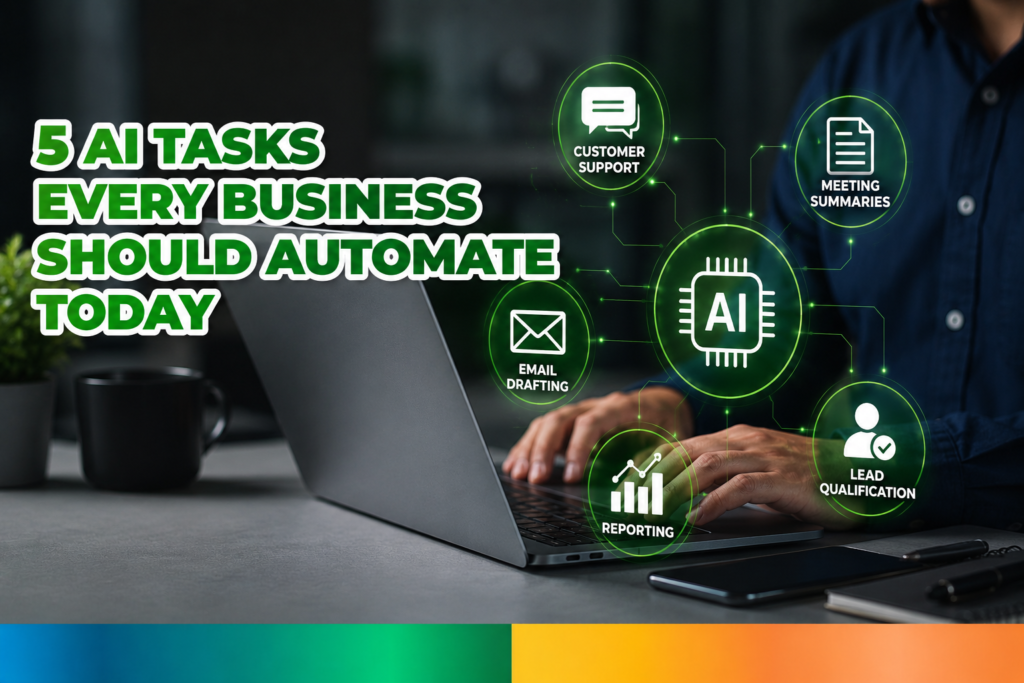
If you’re wondering where to start, here are five AI-powered tasks every business should automate today.
5 AI Automation Tasks for Businesses
1. Lead Qualification
Every inquiry shouldn’t receive the same treatment.
AI can automatically:
- qualify incoming leads
- score prospects based on behavior
- assign opportunities to the right salesperson
- prioritize high-value customers
Instead of manually reviewing every contact, sales teams receive qualified opportunities faster.
This improves response time while increasing conversion rates.
2. Customer Support
One of the most impactful applications of AI is customer service.
Modern AI assistants can:
- answer frequently asked questions
- provide instant support
- route complex cases to human agents
- operate 24/7
According to research from McKinsey, organizations continue expanding AI across customer-facing operations because it improves efficiency while supporting better customer experiences.
Learn more about AI adoption in business through McKinsey’s latest research.
3. Document Processing
Many businesses still spend hours every week processing documents manually.
AI can automatically:
- extract information from invoices
- process contracts
- organize files
- classify documents
- digitize handwritten information
This significantly reduces human error while accelerating administrative workflows.
4. Reporting and Data Analysis
Most companies collect large amounts of data.
Very few actually use it.
AI can automatically:
- generate dashboards
- identify trends
- summarize performance
- detect anomalies
- support decision-making
Instead of waiting days for reports, leaders receive actionable insights almost instantly.
Harvard Business Review has published extensive research on how AI is changing decision-making across organizations.
5. Workflow Automation
Perhaps the most valuable application of AI is connecting systems together.
Instead of isolated software, businesses can automate complete workflows such as:
- website inquiries → CRM
- CRM → email automation
- invoices → accounting
- support tickets → project management
- customer onboarding → internal notifications
This creates a digital ecosystem where information flows automatically between departments.
The result is greater operational efficiency with fewer manual tasks.
AI Should Support Strategy, Not Replace It
Many organizations approach AI by searching for tools first. Successful companies take the opposite approach.
They begin by identifying operational bottlenecks, then implement AI where it creates measurable business impact.
Technology alone doesn’t generate results. But a well-designed system does. That’s why AI should be part of a broader digital strategy focused on efficiency, scalability, and sustainable growth.
AI is about removing repetitive work so teams can focus on innovation, customer relationships, and business growth.
Whether you’re looking to improve customer support, automate reporting, streamline workflows, or optimize lead management, the best time to begin is now.
The companies gaining the biggest competitive advantage are using it more strategically. Learn how to apply it to your company with us!
Frequently Asked Questions
What business processes should be automated first?
Businesses should start with repetitive, time-consuming tasks such as lead qualification, customer support, document processing, reporting, and workflow management. These areas typically deliver the fastest return on investment.
Is AI automation only for large companies?
No. AI-powered tools are now accessible to businesses of all sizes. Many cloud-based platforms offer affordable solutions that help small and medium-sized businesses improve efficiency without large upfront investments.
Will AI replace employees?
In most cases, AI is designed to support employees rather than replace them. It automates repetitive tasks, allowing teams to focus on strategic work, customer relationships, and higher-value activities.
How do I know if my business is ready for AI?
If your team spends significant time on repetitive manual processes, data entry, reporting, customer inquiries, or workflow coordination, your business is likely ready to benefit from AI automation.